AI Without Training on Customer Data: Secure AI for Business
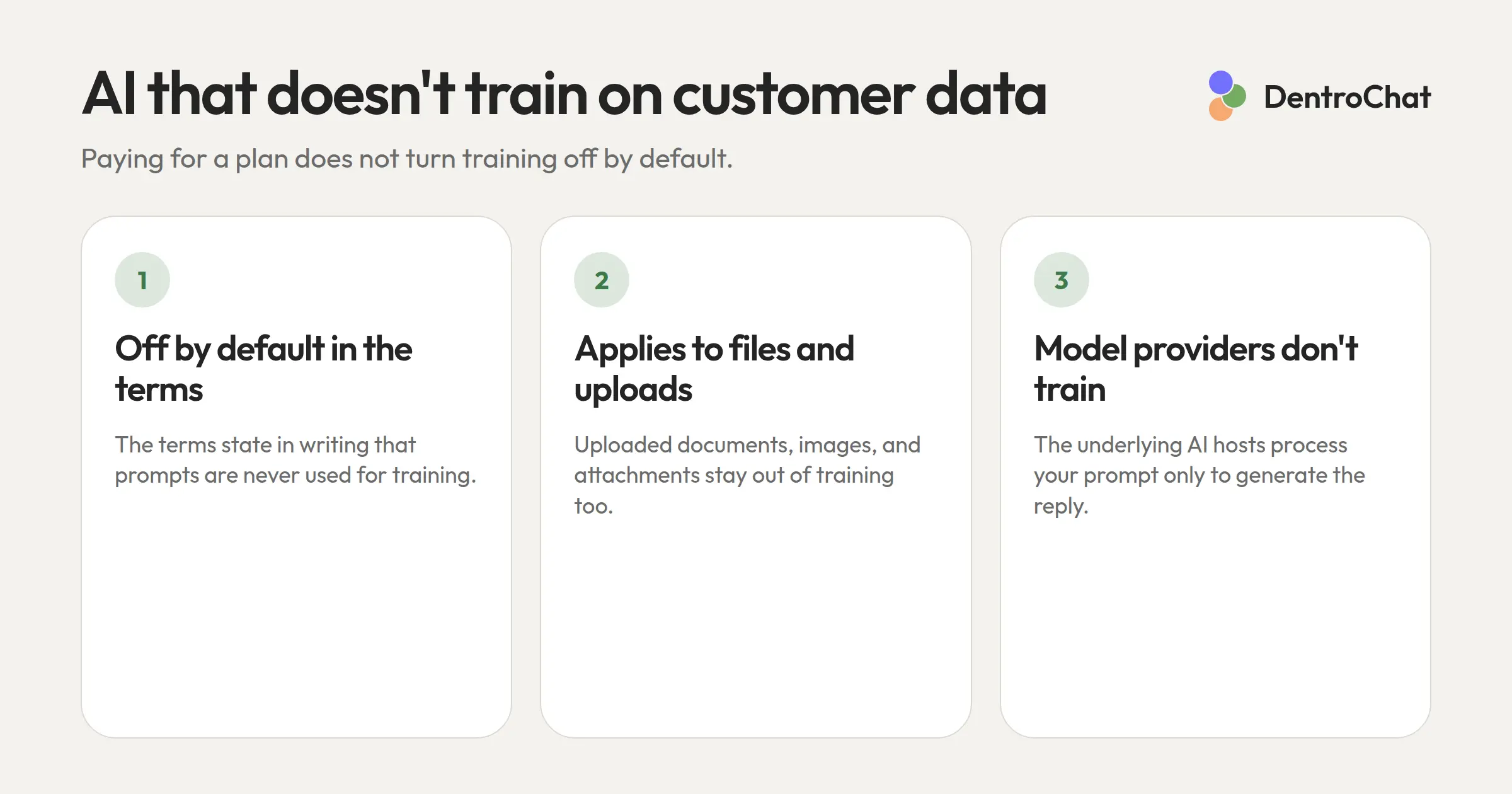
Across Europe, many companies now find it essential to use AI that does not train on customer data.
If your day-to-day work involves contract text, customer messages, or internal strategy documents, you should not feed that information into a system that uses it to train future AI versions.
The GDPR offers plenty of safeguards. Still, the technical reality of many popular AI products often does not match the marketing claims.
This guide helps you understand what to look for in secure AI tools. Which red flags in terms of service should set off alarms. Which concrete steps you can take to make your AI use safer right away.
Why AI without training on customer data matters
In your daily work with AI tools, you probably enter more than a little text. Customer names. Contract details. Support questions. Internal notes. The question is not whether your data gets typed in somewhere, but where, and what happens to it next.
What happens to your data with ChatGPT and similar tools
Many providers write their terms so your inputs can be used to train models. Your prompt about customer data could end up in the training set for a future version.
The model does not learn instantly, but the next release might surface data you once entered. If someone in Mexico suddenly gets customer details about Hans Kreutzer spat out by the model, the fun is over.
Free vs paid? Not the main point
Many people wrongly assume that paying for a subscription automatically means better privacy.
Wrong.
Even on ChatGPT Plus, training options can still be on unless you turn them off yourself. You need to look deeper than the plan tier if you want AI that does not train on customer data. What matters are privacy settings and what the provider actually commits to.
Individual vs enterprise: where the real line is
The meaningful split is not free versus paid, but individual versus enterprise plans. Personal accounts, including Plus or Pro, often ship without a strong privacy promise by default. Enterprise offerings like ChatGPT Enterprise or Microsoft Copilot for Business more often state explicitly that inputs are not used for model training. The main things to check:
-
Clear terms saying prompts are not used for training by default
-
The same protection for uploaded files, PDFs, and attachments
-
The model providers in the stack (subprocessors) also do not train on your inputs
-
No hidden opt-out toggles or carve-outs via feedback buttons
Platforms like dentro.chat are built for exactly this scenario: business use where customer data stays out of model training.
Legal risks when using AI with customer data
GDPR and AI use
As soon as you feed personal data into an AI service, the GDPR applies in full, no exceptions, no grace period. That covers every prompt with a customer name, email address, or contract detail. Whoever uses the tool is processing data under the GDPR and must respect purpose limitation and data minimisation: the input may only be used to compute the answer, not recycled for later model training. It also matters which third parties see your data in the background and which legal regime applies. Many teams only grasp what GDPR compliance means for AI at work after something has already gone wrong. Fines under current law can be steep.
US CLOUD Act: why server location is not enough
Many companies assume they are fine because their AI vendor uses servers in the European Union. Server location covers only part of the question.
A US chat can still be a reasonable choice if it does not train on your data. For overall data protection, it is better to avoid US subprocessors.
US companies fall under the US CLOUD Act, which can require them to hand over data to US authorities on request, regardless of where it is stored physically. A server node in Frankfurt does not remove that exposure.
US authorities can also gag the company about the disclosure. That happened 1,823 times at Microsoft in the first half of 2025 alone.
How to spot secure AI tools
What to ask every provider
Before you roll out an AI tool in your company, ask concrete questions:
-
Is model training excluded by default for chats and uploaded files?
-
Does the no-training rule apply to the AI model providers in the background (subprocessors)?
-
How long are prompts kept for abuse review, and who can access them?
-
Where are servers located physically, and which law governs the operator?
A provider that answers these in writing with specifics shows that privacy is built into the product.
Even without training: retention for abuse review
Even when model training is off, many large providers do not delete your input right after the reply. Plenty of services keep prompts for 30 days or longer for abuse and safety review, sometimes with access by trained reviewers. If you enter confidential customer data, check how long inputs are logged, whether old chats can auto-delete, and who gets access in a support case.
Red flags in the terms of service
Certain phrases should make you stop immediately. Wording like “to improve our models” or “to enhance our AI” applied to your inputs and chat content means your prompts can end up in future training data. Watch out: some vendors use similar language that only refers to anonymous usage statistics, not chat content. Context always matters, see what “improvement” actually refers to. Vague privacy policies with no storage location or retention periods, or no way to opt out of model training, are bad signs too.
Positive signals matter just as much. A serious privacy policy states clearly that inputs are not used to train AI models. It names where data is stored and lists every subprocessor with location. DentroChat’s privacy policy does exactly that: chats are not used for training, all subprocessors are in the EU, and there are no US-based subprocessors.
If you cannot find such clear statements, that is already an answer. If you do not want to read a foreign privacy policy line by line, our Privacy Policy Analyzer helps you spot training clauses and third-country transfers quickly.
Using AI more safely: practical strategies
Even without a perfect tool, you can make your AI use safer immediately. Two measures have the biggest impact.
Anonymise data before you type
When you write a prompt, replace real names, companies, and contact details with simple placeholders like “Customer A” or “Company X”. It can feel clumsy, but it takes seconds and cuts risk sharply, especially if you lack a tool that explicitly promises not to use inputs for model training. For routine tasks like draft text or summaries, anonymisation is often enough.
Internal rules for your team
Individual caution helps little if colleagues paste customer data into random AI tools. Put in writing which data types may go into which tools and which are off limits. EU regulators expect technical and organisational measures as part of every AI deployment. Short team trainings raise awareness without slowing work.
DentroChat: AI without training on customer data
If you want to apply everything above consistently, you need a platform that includes privacy from the start. DentroChat is a European AI alternative designed for privacy-conscious users.
How DentroChat handles privacy
DentroChat runs entirely on European infrastructure and processes all data only within the EU and Switzerland. There are no US subprocessors, so your inputs are not exposed to the US CLOUD Act. That is a structural difference from many popular alternatives. On top of that, AI without training on customer data is a fixed part of the offer.
Who benefits most
Especially European businesses that often handle sensitive customer or contract data. Lawyers, agencies, consultancies. Teams subject to the GDPR. If you want something compliant that still works in daily use without technical tricks, DentroChat is a solid option.
AI without model training on customer data is not a nice-to-have. It is a baseline every business AI use should meet when real customer data is involved. GDPR, the US CLOUD Act, and rising customer sensitivity mean setting the direction now beats expensive fixes later.
Your next step can be quick. Read the terms of your current AI tools. Ask the questions from this article. If the answers are vague or missing, you know what that means.