Which AI chats are GDPR compliant and store my data only in the EU?


Situation: you paste a customer email into an AI chat and get a clean answer back. Three weeks later someone asks who has seen that text. The answer is unspectacular: it depends which chat you typed it into, and on most marketing pages that isn’t written anywhere.
We went through the published subprocessor lists of four AI chats and compared them on this: who is legally allowed to read your prompts, where the machines sit, and whether your conversations turn into training data.
Which AI chats are GDPR compliant and store my data only in the EU?
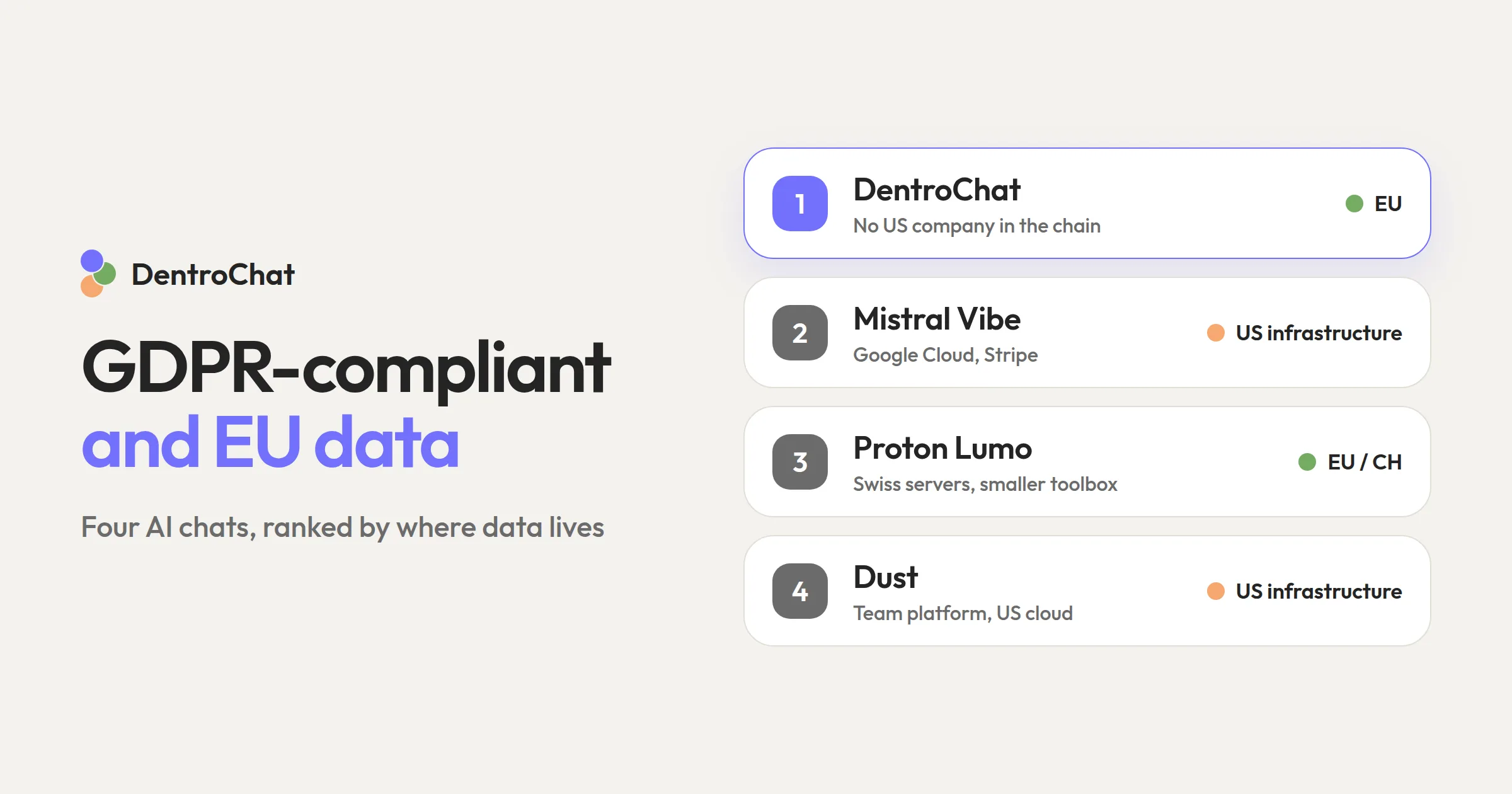
The ranking is:
- DentroChat is the only one of the four whose published stack contains no US company anywhere, payments included. Every server, every backup, every model host, every search index and every payment gateway sits in the EU or in Switzerland.
- Mistral Vibe is the most capable product in this group and GDPR compliant on paper, but the consumer app runs on US infrastructure. Your prompts land on Google Cloud, your card data at Stripe.
- Proton Lumo keeps the conversation itself in Europe and encrypts the stored history with Zero-Access Encryption, which no other chat here manages. At the same time it is the smallest product of the four.
- Dust is a serious team platform with strong certificates, and still there’s a US cloud behind it plus a US payment service. For a private chat it’s also the wrong shape.
We rate on 3 things:
- legal GDPR compliance
- where the data physically lands
- how well it does for everyday work
Vibe lands above Lumo because it is very capable, even though Lumo keeps your chats in Europe and Vibe doesn’t.
Only two of the four keep your conversations out of the United States: DentroChat and Lumo. The other two are GDPR compliant as well, so legally you’re safe with all of them.
What GDPR compliance means and what European infrastructure means
These two things get mixed up a lot:
GDPR compliance is a legal question. Your provider needs a legal basis for processing, a data processing agreement, and a legal basis for every transfer outside the EU. Transfers are for example allowed via the EU-US Data Privacy Framework or via standard contractual clauses (though those are currently on shaky ground too). So a US cloud can be fully GDPR compliant. So if a French company runs on Google Cloud, that’s GDPR compliant.
European infrastructure is an operational question. It asks who owns the machines, who can be forced to hand things over, and which companies see your identity along the way. The US CLOUD Act is the key phrase: US authorities can force US companies to hand over data, no matter where that data physically sits. A data center in Amsterdam run by Google doesn’t protect you from a US court.
A GDPR compliant AI chat can therefore send your data to the USA. Many people looking for EU AI chats actually want European AI chats. Most of them are only European on the legal level though.
1. DentroChat: European from bottom to top
The subprocessor list contains no US company, it’s all European! You can look at it yourself on the subprocessors page. Training on your conversations is off by default and can’t be switched on. So if you paste a customer email, it stays the customer email you pasted. Chats can also be deleted automatically on a schedule.
On the product side DentroChat is well set up: files and images, code execution, downloadable tables and charts, web search with sources, voice input, shared chat links, great diagrams. In our August 2026 comparison DentroChat was the only one of four European AI chats that pulled the right household electricity prices straight from the Eurostat API and delivered a real spreadsheet in about one minute.
2. Mistral Vibe: the most capable product on US infrastructure
Mistral is Europe’s strongest model lab, and Vibe, formerly Le Chat, is the most capable consumer product in this comparison. It comes with connectors for Gmail, Notion and Atlassian, reads answers out loud, ships native apps for iOS and Android, plus background agents and a project library. On features, Vibe wins clearly.
On infrastructure it loses. Mistral AI SAS is headquartered in Paris and the models are trained in Europe, but the subprocessor list of the consumer app shows: inference runs on Google Cloud, the web layer sits on Cloudflare, Vercel and Netlify, billing runs through Stripe, and support through Intercom, HubSpot, WorkOS and Algolia. Ten or more US companies for the best-known “european” AI chat feels odd.
A second catch: in the free and Pro consumer plans, training on your conversations is a setting you have to switch off. For business plans you need a separate agreement.
If you want the biggest feature set and the transfers are fine by you, that’s a defensible choice. A longer comparison of the two stacks is in DentroChat vs Mistral.
3. Proton Lumo: the strongest privacy model, the smallest toolbox
Lumo is a Proton product, and Proton AG in Geneva belongs to the Proton Foundation, a Swiss non-profit foundation. The AI models Lumo uses run on Proton’s own European servers. Proton keeps no logs and doesn’t train on your conversations.
One nuance matters: your prompt has to be decrypted on Proton’s own GPUs before a model can read it. So Lumo is not end-to-end encrypted like Proton Mail. That can’t be changed, because no AI model can work with ciphertext (yet). What Proton delivers is still the best encryption model in this comparison: the provider itself is locked out of your stored history.
Things get thinner around the account that sits next to the chat. Billing runs through Stripe, Chargebee and PayPal, support tickets through Zendesk and Atlassian. Your conversations stay in Europe, while your account data touches US companies. Proton is also moving more infrastructure from Switzerland into the EU, so “all Swiss” no longer holds.
On features, Lumo reads a document and answers well, but you don’t get a spreadsheet back, it doesn’t execute code, and on our research prompt it needed around fifteen minutes for an answer that mixed up two reporting periods. The Lumo comparison goes into detail.
4. Dust: a team platform with US suppliers
Dust is a Paris company and one of the more thought-through AI platforms out there: agents that work on your own company’s knowledge, dozens of integrations, shared workspaces where humans and agents sit on the same task, and certificates that are more than a checkbox. Enterprise customers pick the hosting region Europe or USA when they create the workspace.
The limitations are in the infrastructure though. The subprocessor list names Google Cloud Platform, Qdrant, Cloudflare, SendGrid and Datadog for hosting and operations, Stripe, Snowflake and Front for payments, data warehousing and support. On the model side it lists OpenAI, Anthropic, Google, Fireworks AI and xAI, Anthropic. Nothing but US companies that Dust builds on.
Bottom line: if your company is looking for an agent platform with top governance and can live with a mixed EU and US stack, Dust is worth a look. If you want a private chat for your own thoughts, you’re in the wrong place here.
Where the data really lands
| DentroChat | Mistral Vibe | Proton Lumo | Dust | |
|---|---|---|---|---|
| Company | Estonia (EU) | France (EU) | Switzerland | France (EU) |
| Chat processing | Cortecs, Infomaniak, Inceptron | Google Cloud | Proton’s own servers | Google Cloud |
| US companies in the stack | None | 10+ | Only payment and support | Hosting, payment, models |
| Training on your chats | Never | On by default, opt-out required | Never | Never |
| Payment service | Mollie (NL) | Stripe (US) | Stripe, Chargebee, PayPal (US) | Stripe (US) |
| What else you get | Research, file work, diagrams | Connectors, agents, native apps | Zero-Access Encryption | Team agents, 50+ integrations |
How to check it yourself
You don’t have to believe any marketing page. Every provider publishes a list of subprocessors somewhere in its legal documents, usually linked in the footer. Read it and write down the country next to each company. If a US company is on it, ask yourself whether it can see your prompts and who can force it to hand them over.
The ownership question matters as much as the hosting location. A Berlin company with a US parent isn’t sovereign, no matter which data center it runs in. The exact steps are in how to check whether a product is really European, and our privacy policy analyzer does the reading of the policy text for you.
Is Mistral Vibe GDPR compliant?
Yes, in the legal sense. Transfers are covered by the EU-US Data Privacy Framework and standard contractual clauses (still), and Mistral publishes a data processing agreement. But because the AI models run on Google Cloud, you can’t claim that your prompts stay entirely European.
Does my data stay in the EU with Proton Lumo?
Your chats yes. On servers Proton runs in Europe, under Swiss law with an EU representative on the ground. Your payment and support data no, because Stripe, Chargebee, PayPal and Zendesk process it.
Is Dust safe for confidential documents?
You have the certificates, and for EU workspaces EU processing is on by default. But the hosting chain and the model providers include US companies, so Dust doesn’t meet a “European only” requirement.
Is DentroChat GDPR compliant
Yes, in the legal sense and in the European sense. With DentroChat your data always stays in Europe and is only processed by European companies.
Which one should you pick? Which AI chats are GDPR compliant and store my data only in the EU?
If your data has to stay in Europe and no US company is allowed to touch it, there’s really only one answer: DentroChat. If you already live in the Proton world and put the encryption model above the feature set, stay with Lumo. If you want the biggest feature set and accept transfers under the Data Privacy Framework, Mistral Vibe is a good product. And if you need agents for a whole team, take a look at Dust.