How much energy does an AI prompt use?
Users of DentroChat, our EU AI Assistant sometimes ask us how much power is spent on their messages. That’s a reasonable question. We’d like to have a number in the product, but the companies who run the models on the cloud are for the most part still not providing the energy for a single request. So we did our best to approximate it using public research.
These aren’t lab measurements of DentroChat. We read through the studies we could find and checked them against each other, and the numbers below are where they land. If you have a better source, please let us know.
Electricity for a normal prompt
A typical prompt is: you ask a question, and the model gives a response in a few hundred tokens. A token is a piece of a word, or one word if it’s a short word.
This was measured by Google. In May 2025 the median text prompt in their Gemini apps was 0.24 watt hours. This included chip and cooling of the whole hall of their data center. Google calculated that for the median prompt, CO2 is 0.03 grams (for the Google electricity).
Epoch AI estimated a typical response in ChatGPT in February 2025 at roughly 0.3 watt hours. They estimated a response with 500 tokens or so. They said their estimation is a bit high.
A paper in Joule from April 2026. The data was from 2025 deployments. They estimated the median for a large model at 0.31 watt hours. Sam Altman posted in June 2025 that average query on ChatGPT is ~0.34 watt hours.
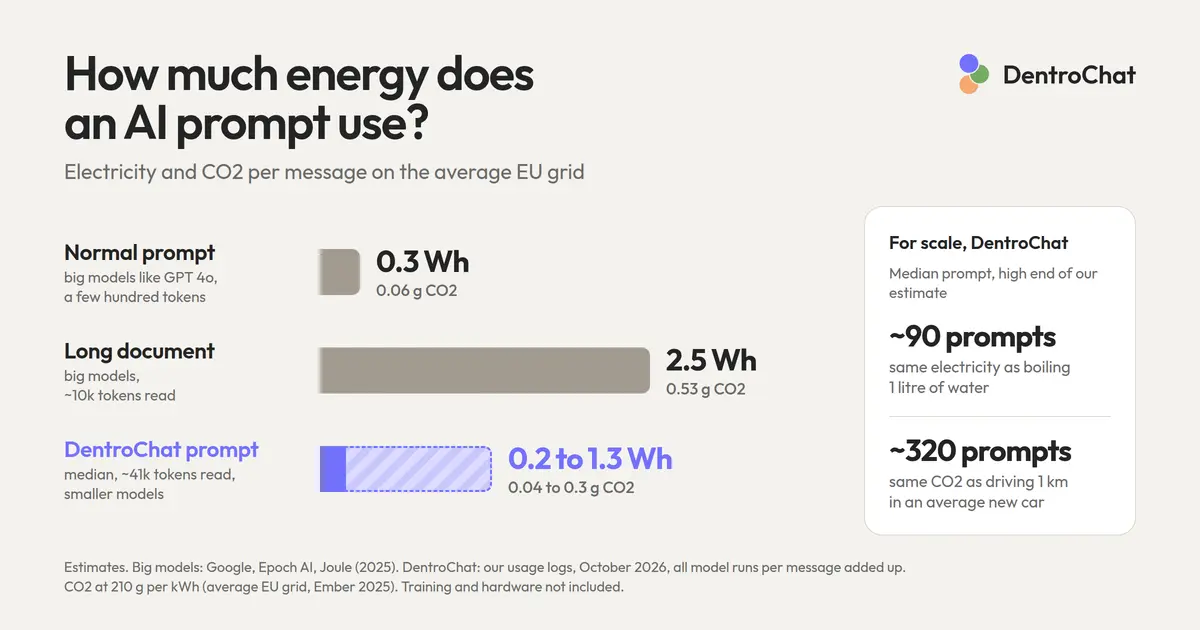
For a typical prompt: we would say 0.3 watt hours. The measurement and the estimations both come out to the same.
Electricity for a longer prompt
A long document is more work because you have to read a lot.
Epoch AI estimated something like 10k tokens of input would lead to about 2.5 watt hours for such a query. To show what that is in words, we counted tokens on our own pages. The counts here use the GPT 4o tokenizer: about 7,700 English words and about 5,800 German words, so a long article or a chat with many messages. Further down we also ran the same pages through five other tokenizers, and that table shows how far they sit from GPT 4o.
Jegham et al did their own estimate for such a prompt of 10k in, 1500 out. It was between ~1.4 and 2.9 watt hours depending on the model. So similar ballpark as Epoch.
If the model thinks long and writes thousands of tokens before the response appears, then more electricity is used. In the Joule paper they put a 5k token response or so at ~4 watt hours. That is a “reasoning” style answer where the model thinks a lot.
Here is all of it in one table. These are all big models like GPT 4o and Gemini:
| Kind of prompt | Tokens, roughly | Electricity | Where it comes from |
|---|---|---|---|
| Normal prompt | short question, a few hundred tokens back | ~0.3 Wh | Google, Epoch AI, Joule paper, Altman |
| Long document | ~10k in, 500 to 1,500 out | ~2.5 Wh (1.4 to 2.9) | Epoch AI, Jegham et al |
| Reasoning answer | ~5k out | ~4 Wh | Joule paper |
In words: a normal prompt uses about 0.3 watt hours. A long document of about 10k tokens uses about 2.5 watt hours, somewhere between 1.4 and 2.9 depending on the model. A long reasoning answer of about 5k tokens uses about 4 watt hours.
CO2 depends on the grid
Electricity for the same model is more or less the same for where the servers are. But the CO2 depends on the local power grid.
We took the numbers from Ember, 2025, which you can see in “Our World in Data”, and are lifecycle numbers. They include the electricity supply chain on top of the emissions of the power plant. It is measured in grams of CO2 equivalent per kilowatt hour.
We multiplied that with our two numbers, 0.3 Wh for a normal prompt and 2.5 Wh for a long document:
| Grid | g CO2e per kWh | Normal prompt | Long document |
|---|---|---|---|
| Norway | 28 | 0.01 g | 0.07 g |
| Sweden | 35 | 0.01 g | 0.09 g |
| France | 41 | 0.01 g | 0.10 g |
| Finland | 57 | 0.02 g | 0.14 g |
| Denmark | 114 | 0.03 g | 0.29 g |
| Austria | 117 | 0.04 g | 0.29 g |
| Spain | 154 | 0.05 g | 0.38 g |
| EU average | 210 | 0.06 g | 0.53 g |
| Netherlands | 254 | 0.08 g | 0.63 g |
| Italy | 285 | 0.09 g | 0.71 g |
| Estonia | 319 | 0.10 g | 0.80 g |
| Germany | 330 | 0.10 g | 0.82 g |
| United States | 384 | 0.12 g | 0.96 g |
| Poland | 589 | 0.18 g | 1.47 g |
In words: in Sweden (35 g per kWh) and France (41 g) a normal prompt is about 0.01 grams of CO2, and a long document about 0.1 grams. On the EU average (210 g) a normal prompt is about 0.06 grams and a long document about 0.5 grams. In Germany (330 g) a normal prompt is about 0.1 grams and a long document about 0.8 grams. Poland is the highest in the table at 589 g, so a normal prompt is about 0.18 grams and a long document about 1.5 grams. The US is in there because a lot of the ChatGPT numbers were made there. At 384 g it’s about 0.12 grams for a normal prompt and about 1 gram for a long document.
In Germany, the environment agency says similar things for 2025. They say generation CO2 of 344g/kWh and supply chain CO2 equivalent is 406g. Electricity Maps say for actual consumption of electricity by people in Germany it was 335g in 2025. Single hours can be from ~100g to ~600g.
What about DentroChat?
All the numbers so far are for big models like GPT 4o. Epoch assumed that about 100 billion parameters work on every token, but DentroChat often uses smaller models. They are “mixture of experts” models, which means the model is big, but only a small part of it does the work for each token. DeepSeek V4 Flash uses about 13 billion parameters per token, GLM 5.3 Flash about 18 billion and Qwen 3.8 Flash Next about 6 billion.
Fewer working parameters means less electricity per token, and so less CO2 per token. The ML.ENERGY leaderboard measured this with their GPUs. A Qwen model with 22 billion working parameters needed about 0.12 Wh per 1,000 tokens written. DeepSeek V3.1 with 37 billion needed about 0.37 Wh. That’s the graphics cards only, so we added cooling and the rest of the servers on top. Our models are smaller than both, so this is our estimate:
| Per 1,000 tokens | Parameters working per token | Written | Read, fresh | Read, cached | CO2 for 1,000 written, EU average |
|---|---|---|---|---|---|
| GPT 4o (Epoch’s assumption) | ~100 billion | ~0.6 Wh | ~0.2 Wh | ~0.13 g | |
| DentroChat models (our estimate) | 6 to 18 billion | 0.05 to 0.4 Wh | 0.01 to 0.07 Wh | 0.001 to 0.007 Wh | 0.01 to 0.08 g |
In words: for GPT 4o, Epoch’s numbers work out to about 0.6 watt hours for every 1,000 tokens the model writes, and about 0.2 for every 1,000 tokens it reads. For the models in DentroChat we estimate 0.05 to 0.4 watt hours per 1,000 tokens written and 0.01 to 0.07 per 1,000 tokens read. If the text was already read a few minutes before, it is cached, and then it’s about a tenth of that again. On the EU average grid, 1,000 written tokens are about 0.13 grams of CO2 for GPT 4o and 0.01 to 0.08 grams for our models.
But our prompts are bigger than the “normal prompt” in the studies. Every message also sends the model its instructions and the descriptions of its tools, which is already about 3k tokens. On top of that comes your memory, the chat so far, and any files or web search results. When the model uses a tool, it reads all of that again. For example, it first decides to search the web, and then it reads the whole chat again together with the search results to write the answer. So one message from you can mean several runs of the model.
All numbers in the table below are per message you send. If one message made the model run several times, we added those runs up into one row.
So we looked at our own usage logs and counted the tokens (we of course don’t read what you write). The table uses 606 prompts from one day in October 2026. We also checked the 21,700 prompts of the 30 days before, and the median was very similar:
| DentroChat prompt | Tokens read | of which cached | Tokens written | Electricity (our estimate) | CO2, EU average | CO2, Germany |
|---|---|---|---|---|---|---|
| Median | ~41k | ~30k | ~900 | 0.2 to 1.3 Wh | 0.04 to 0.3 g | 0.06 to 0.4 g |
| Top 10% | ~131k | ~66k | ~4,600 | 1 to 7 Wh | 0.2 to 1.4 g | 0.3 to 2.3 g |
In words: the median DentroChat prompt reads about 41k tokens, and about 30k of those are cached because they were sent a few minutes before. It writes about 900 tokens. We estimate that at 0.2 to 1.3 watt hours, which is about 0.04 to 0.3 grams of CO2 on the EU average grid, and 0.06 to 0.4 grams in Germany. The top 10% of prompts read 131k tokens or more and write 4,600 or more. That’s about 1 to 7 watt hours, or 0.2 to 1.4 grams of CO2 on the EU average and 0.3 to 2.3 grams in Germany.
For the top 10% row we took the line for each column on its own. A real prompt rarely hits all of them at once, so that row is on the heavy side on purpose.
There’s also work in the background, like updating your memory and summarizing long chats. Sometimes a model is too slow and we switch to a backup model halfway through. Those runs are not in the table. If we spread them over all prompts, the average prompt reads about 76k tokens (50k cached) and writes about 2k. That lands at about 0.4 to 3 watt hours.
So a DentroChat prompt reads a lot more than the normal prompt from the studies. Each token is cheaper though. So the median DentroChat prompt (0.2 to 1.3 Wh) is close to the normal prompt of the big models (0.3 Wh) at the low end, and about half of their long document (2.5 Wh) at the high end.
In comparison: A kettle, and short drive
It takes roughly 100 watt-hours of heat to heat up one liter of water from tap to boiling. Some of it doesn’t make it into the water, so at the plug it is more like 110-125 watt-hours.
A median DentroChat prompt is a small piece of that. We use the high end of our estimate, 1.3 watt hours, so the comparison stays on the heavy side. At that rate you’d need about 90 DentroChat prompts to match one litre.
For the car we take the average number for new cars in 2025 from the European Environment Agency. It’s 96.7g CO2 per km, according to lab tests. The average includes electric cars though and they count as zero exhaust, so you’d expect a gasoline car to be a little more thirsty on the road.
So for every kilometer you drive in that average new car, you could send about 240 median DentroChat prompts in Germany. That’s the high end again, 0.4 grams of CO2 per prompt. On the average EU grid the same prompt is 0.3 grams, so you get about 320 prompts per kilometer.
Language affects # of tokens
Different languages use different number of tokens to tokenize the same page. We ran our own articles through tokenizers for all 17 languages DentroChat supports.
We used 22 of our blog posts, which exist in every language, so it’s the same text each time. The main number is the GPT 4o tokenizer. The range is the lowest and highest we got across six tokenizers (GPT 4o, GPT 4, Mistral, Llama 3, Qwen 2.5 and DeepSeek V3).
| Language | Tokens per word | Range | Words in 10k tokens |
|---|---|---|---|
| English | 1.3 | 1.3 to 1.4 | ~7,700 |
| Spanish | 1.4 | 1.4 to 1.7 | ~7,200 |
| Portuguese | 1.4 | 1.4 to 1.7 | ~7,000 |
| French | 1.4 | 1.4 to 1.7 | ~6,900 |
| Dutch | 1.6 | 1.6 to 2.1 | ~6,300 |
| Italian | 1.7 | 1.7 to 1.9 | ~6,000 |
| German | 1.7 | 1.7 to 2.1 | ~5,800 |
| Norwegian | 1.9 | 1.9 to 2.2 | ~5,400 |
| Swedish | 1.9 | 1.9 to 2.3 | ~5,300 |
| Danish | 1.9 | 1.9 to 2.3 | ~5,300 |
| Romanian | 1.9 | 1.9 to 2.2 | ~5,300 |
| Croatian | 2.1 | 2.1 to 2.6 | ~4,800 |
| Polish | 2.2 | 2.2 to 2.6 | ~4,500 |
| Greek | 2.4 | 2.4 to 5.9 | ~4,200 |
| Estonian | 2.5 | 2.5 to 3.1 | ~4,000 |
| Hungarian | 2.6 | 2.5 to 3.1 | ~3,900 |
| Finnish | 2.8 | 2.8 to 3.5 | ~3,600 |
In words: on the GPT 4o tokenizer English is about 1.3 tokens per word, so 10k tokens is about 7,700 English words. Spanish, Portuguese and French are close behind at about 1.4. Dutch is about 1.6, and German and Italian about 1.7, so 10k tokens is about 5,800 German words. The Nordic languages except Finnish sit around 1.9. Estonian is about 2.5 and Finnish is the highest at about 2.8, so 10k tokens is only about 3,600 Finnish words.
Often people say a German word is 3 tokens. On modern tokenizers we measured more like 2. Greek has the big range because older tokenizers handle the Greek alphabet badly.
So the Finnish document, for the same length, uses more tokens. And therefore more electricity. Same g CO2/wh from the grid above.
What we didn’t cover
This is the electricity for one answer to one message.
Model training was done previously in one go, and it’s also shared between everyone that uses it. It would be guesswork to assign training cost to your prompt, so we left it out.
There’s the cost to manufacture the graphics cards. Nvidia’s breakdown for a single H100 board. It’s 1312kg of CO2 equivalent for 8 GPUs. That’s for a few years of operation. For one prompt you’re only carrying a small fraction of that. It’s well under 1g. On a clean grid like Sweden, that fraction can come close to the CO2 of the electricity itself. On the German grid the electricity is much bigger.
Then there’s water. The viral claim that AI drinks a bottle of water comes from a 2023 estimate for GPT 3: about 500 ml for 20 to 50 answers, in hot US data centers that cool by evaporating water. Google measured 0.26 ml for a median Gemini text prompt (~five drops of water). But many European data centers cool with outside air and use hardly any water at all!! That includes Hetzner in Germany, where DentroChat is hosted, and the Swedish data centers where some of our models run. We wrote more about it in is AI wasting water? and a more detailed explanation on why the viral water numbers are misleading.
There’s also this practical point. If you’re in the same chat, the long document is usually held in memory for a few minutes. So the next message is mostly processing the new text. OpenAI and Anthropic both talk about caches that expire after, like, 5-10 mins of inactivity. That’s the “cached” column in our DentroChat table. It also helps when the model runs several times for one message, because the second run can reuse what the first one already read.
We’d still like to show you a real watt hour number for every message in DentroChat, the best EU AI Chat. For that, the providers who run the models would have to tell us the energy of each request, and most of them don’t do that yet.
Until then, this is our best approximation. On big models like GPT 4o, a normal prompt uses about 0.3 watt hours and a long document about 2.5. A median DentroChat prompt on our smaller models uses about 0.2 to 1.3 watt hours. On the EU average grid that’s at most about 0.3 grams of CO2.