
Is AI wasting water? Myth or not, if you use EU infrastructure
“AI is wasting all our water”. Is that a myth or not? We went looking!
The question landed on us directly. One of our founders, Paul Plessing, got a rough ride in a Reddit thread over the “excessive waste of water” of AI and its data centers. The tone was harsh, but the underlying question is fair, so we went and read the research.
Where does the bottle-of-water number come from?
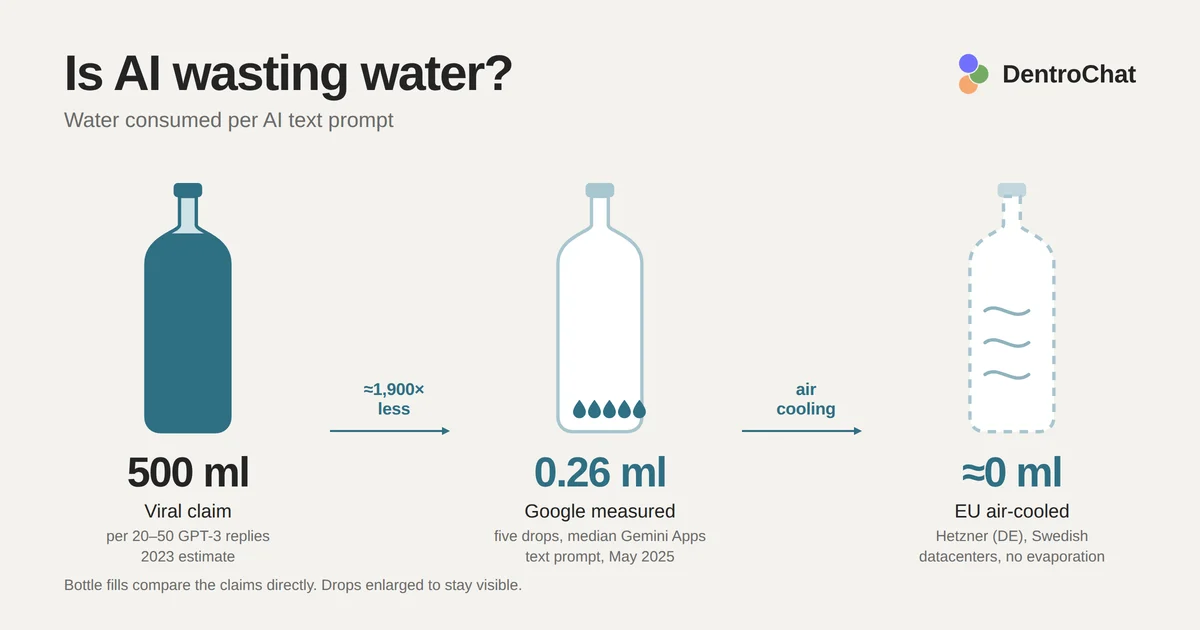
The main source behind “AI wastes water” is legit: Li et al., “Making AI Less Thirsty” (UC Riverside), which estimated that GPT-3 uses roughly a 500 ml bottle of water per 20–50 responses.
But those per-response figures are extrapolations. They assume hot-climate datacenters with evaporative cooling.
Evaporative cooling is sweating at industrial scale: warm air is pushed past water, the water evaporates and carries the heat away with it, and that water is gone instead of going back to where it came from. It saves a lot of electricity, which is why hot regions use it. However, it costs a lot of water.
But what do measured numbers show?
Google later published measured numbers: the median Gemini Apps text prompt consumes 0.24 Wh and 0.26 ml of water, including cooling and idle overhead. That is about five drops of water. The number comes from a point-in-time analysis of May 2025 data, so it is a median across whatever models were serving traffic rather than one named model. And that 0.26 ml was Google’s global average.
If you want the longer methodology breakdown, we already wrote AI water consumption: why the viral numbers are misleading. This piece is about what changes when your EU AI Chat runs on servers that sit in Europe.
Do European datacenters even use water to cool?
Datacenters in Sweden are there in part because they cool with air instead of water. Microsoft’s Swedish region cools with outside air 100% of the year. Hetzner also uses air for cooling instead of water.
That is not a random list. DentroChat hosts on Hetzner in Germany, and some of the inference we route through Cortecs runs in Sweden. Saying “AI is wasting water” is a stark overstatement if you use an EU AI Chat such as DentroChat. Many of those European datacenters use almost no water at all.
What about the water used to train the model?
What’s missing from the figures above is the sunk cost of AI training. Once a model is trained, it can be hosted. But most EU-hosted AI models are still trained outside Europe, so we also have to look at training cost.
It’s hard to find recent numbers, but Google estimated in 2022 that 40% of energy went into model training, while 60% went into inference.
The more recent paper “Power Hungry Processing” estimated that inference can account for ~90% of lifecycle energy and carbon.
Both point toward the same thing: an EU AI Chat running European-hosted models wastes little water overall.
How does that compare to a Reddit thread?
Now compare this to the Reddit post which got 6,000 views and kicked off our research.
Web carbon calculators based on the Sustainable Web Design model put a typical page view at ~0.36 g CO₂e, roughly 0.7 Wh. At 6,000 views, that is about 4.4 kWh just to serve the page. That’s the energy of roughly 18,000 AI text prompts!
On water, it’s also roughly litres versus a fraction of a millilitre per prompt.
So, seems like normal social media is worse than AI energy wise…
So is “AI is wasting water” a myth?
Datacenters in dry regions are a real issue, and disclosure is poor. But per interaction, on EU infrastructure, a prompt is one of the lighter things we do online.
“AI is wasting water” is more of a myth if you use EU solutions. That is the kind of European AI we run at DentroChat, the best EU AI Chat.